Baby
The Baby is a minor but pivotal character in Alice's Adventures in Wonderland, encountered in the Duchess's chaotic kitchen, whose startling transformation into a pig crystallizes the arbitrary and unstable nature of identity in Wonderland. The Baby appears only briefly, but its metamorphosis serves as one of the most vivid illustrations of the fluid boundaries between human and animal, child and beast, that Alice must navigate throughout her dream.
Identity and Introduction
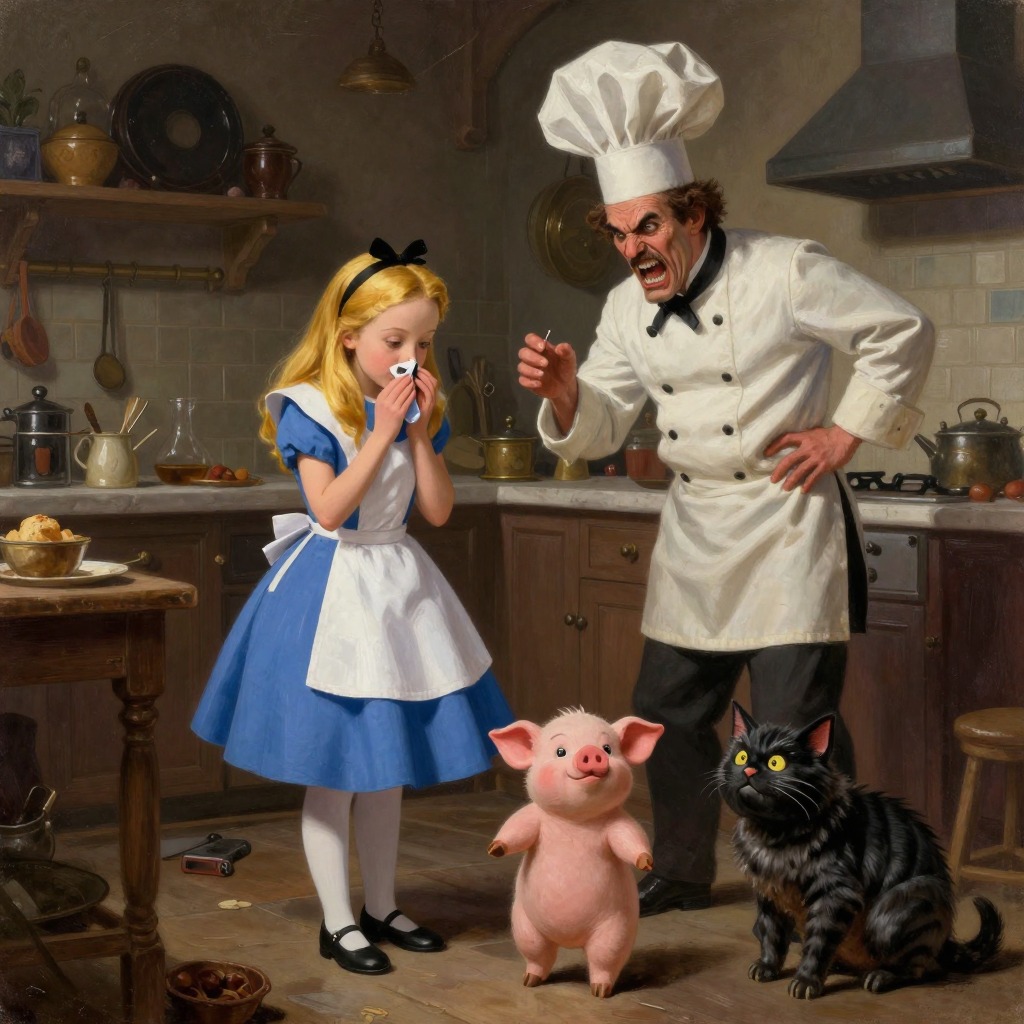
The Baby is first seen in the Duchess's kitchen, a space filled with smoke and pepper that causes constant sneezing. The Duchess sits on a three-legged stool, nursing the Baby, while the cook stirs a large cauldron of soup. The Baby itself is described as sneezing and howling alternately without a moment's pause, and the only creatures in the kitchen that do not sneeze are the cook and a large cat grinning on the hearth—the Cheshire Cat. When Alice asks why the cat grins, the Duchess replies, "It's a Cheshire cat," and then suddenly shouts "Pig!" at the Baby, revealing the Duchess's violent and dismissive attitude toward the child.
Arc Through the Plot
The Duchess, after singing a violent lullaby that includes the lines "Speak roughly to your little boy, / And beat him when he sneezes," flings the Baby at Alice and hurries off to play croquet with the Queen. Alice catches the Baby with difficulty, noting it is a "queer-shaped little creature" that holds out its arms and legs in all directions, "just like a star-fish." The Baby snorts like a steam-engine and keeps doubling itself up and straightening itself out. Alice discovers the proper way to nurse it is to twist it into a sort of knot and hold tight to its right ear and left foot. She carries it outside, thinking that if she does not take it away, the creatures in the kitchen will surely kill it in a day or two. As she looks into its face, she notices its nose is turning up, becoming more like a snout, and its eyes are getting extremely small. When the Baby grunts violently, Alice realizes there can be no mistake: it is neither more nor less than a pig. She sets it down, and it trots away quietly into the wood.
Relationships and Conflict
The Baby's primary relationship is with the Duchess, who treats it with casual cruelty—shaking it violently, singing a lullaby about beating it, and flinging it at Alice without concern. The cook also contributes to the chaos by throwing pots and pans at both the Duchess and the Baby. Alice, in contrast, shows concern for the Baby's welfare, initially trying to protect it from the violent household. However, when the Baby transforms into a pig, Alice's attitude shifts pragmatically: she feels relieved to see it trot away, remarking that while it would have made a dreadfully ugly child, it makes rather a handsome pig. This moment reflects Alice's growing acceptance of Wonderland's logic, where identity is not fixed but subject to sudden, absurd change.
Change and Ending
The Baby's transformation is the central event of its brief arc. The change is gradual but unmistakable: first a turn-up nose like a snout, then extremely small eyes, then a violent grunt. Alice's response—"If you're going to turn into a pig, my dear, I'll have nothing more to do with you"—shows her attempt to impose a boundary, but the transformation proceeds regardless. Once the pig trots away, the Baby disappears from the narrative, though it is later recalled in Alice's sister's dream at the story's end, where she imagines "the pig-baby was sneezing on the Duchess's knee, while plates and dishes crashed around it." This final image reinforces the Baby's role as a symbol of the chaotic, unstable, and morally ambiguous world of Wonderland.
Thematic Significance
The Baby's transformation into a pig is one of the most direct examples in the book of the instability of identity and the breakdown of categories. It echoes Alice's own anxieties about who she is—she wonders if she has been changed for Mabel or Ada, and she cannot keep the same size for ten minutes together. The Baby's change is more radical: it crosses the species boundary entirely. The Cheshire Cat, when asked about the Baby, simply says "I thought it would," suggesting that such transformations are natural in Wonderland. The episode also comments on the arbitrary nature of social roles and expectations: the Duchess's violent parenting, the cook's indiscriminate throwing of objects, and Alice's pragmatic acceptance of the pig all point to a world where conventional morality and identity are suspended. The Baby, in becoming a pig, is not punished or rewarded but simply becomes what it always was, in a place where "everything's got a moral, if only you can find it."